Blog banner featuring Dr. Marie-France Roux and a clinical case Blog banner featuring Dr. Marie-France Roux and a clinical case Blog banner featuring Dr. Marie-France Roux and a clinical case
Blog banner featuring Dr. Marie-France Roux and a clinical case

Same-Day Rejuvenation: 360˚ Veneers with Bioclear Matrices

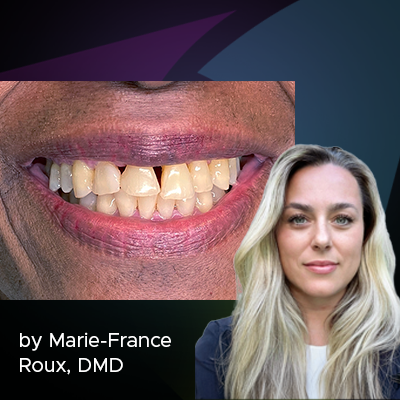
70-year-old female patient presented with severe bone loss and extreme black triangles due to decades of periodontal disease (Fig. 1). The patient’s chief complaints included unsightly gaps between her teeth and an inability to pronounce certain words due to bumping into her upper central left incisor whenever her jaw jutted forward to pronounce Ts and D’s (Fig. 2).


This was distressing to her as she is a stage actor and must be able to speak at length during her performances. The patient is followed by a periodontist every three months for hygiene maintenance, has undergone multiple rounds of SRP’s over the years, and is currently deemed highly motivated in upkeeping her oral hygiene. Despite the bone loss, her dental condition shows only a mobility of 1+ on the upper anterior segment.

FIG. 1
70-year-old female with chronic, but stable periodontitis 
consults for options to close her black triangles.

FIG. 2
The negative space is unsightly and affects her phonetics.

This patient requested an immediate transformation due to some professional deadlines. She was also looking for an alternative approach to a fixed restorative, which would be a lengthier and more expensive treatment.
We had a frank and open discussion about the possibility of not being able to fully close the massive black triangles. However, there was undeniable hope of improving her current situation. It is important to emphasize the aesthetic limitations of this restorative technique (Bioclear overmolding) in order to manage patient expectations. 
 

In this particular case, the patient was thrilled to get any improvement on her situation, and to do it in a single appointment!

Patient Expectations

This patient’s goal was to eliminate the negative spaces between her teeth, immediately improve the aesthetics of her smile, and readily regain function and phonetics of her upper anterior segment.

Planning the Case

As American author and speaker Dr. Stephen Covey famously wrote in his Best-seller The 7 Habits of Highly Effective People, ‘Begin with the end in mind.’

Part of the initial assessment must establish whether the patient requires incisal reduction. In other words, does the patient simply need black triangle closures, or would they benefit from:

1. Correcting the emergence profile on the facial by way of a root overlay.
2. Reconstructing the incisal edge by way of an incisal overlay.


In this case, the patient needed a prosthodontic repositioning of tooth 21, showed a pronounced tooth-size discrepancy between 11 and 21, and needed a midline reset.
 

Reverse engineering the case is essential in planning the cut-back necessary for achieving strength and longevity of the final restorations.
 

Due to the asymmetry between the patient’s centrals, tooth 21 was initially reduced to match the incisal length of 11 (Fig. 3). Then, it was cut back further by an additional 1.5 mm to secure adequate reduction and allow for an incisal wrap-around of the injection moulding. To achieve a predictable outcome when doing 360° Veneers, it is mandatory to respect specific guidelines–the composite height at the incisal edge must be no less than 1.5 mm, with the final restoration’s incisal thickness set at 2 mm.

FIG. 3
Previous bonding is partially (or fully) removed, as needed, and anew smile line is designed. The author used tooth 11 as a starting point to recreate the shape
 and length of sextant 2. Proper cutback and arch optimization must be achieved prior to injectionmolding.

The Bioclear Method uses thin mylar, tooth-shaped matrices, which serve both as a mould into which to inject the heated composite but also provide a visualization of the final shape.


During the initial consult, it is important to measure the gingival embrasures using the Bioclear Black Triangle Gauge (Fig. 4). Then, proceed with a matrix try-in to gauge
the accuracy of the measurement and subsequent matrix selection meant to fill the embrasure (Fig. 5). Clinician experience and a mindful eye for aesthetics guide the final selection of the matrix best suited to re-create the proper emergence profile. In this case, we agreed with the patient to fill the embrasures from 13 to 23 and use Bioclear Black Triangle Matrices to perform 360° Veneers to reshape and rebuild both facial and incisal profiles.

FIG. 4A

FIG. 4B

FIG. 4C

At the initial consultation, shade match is achieved using composite pellets placed and cured on the facial of the central incisors. Each embrasure is measured and recorded using the Bioclear Black Triangle Gauge.

FIG. 6
Matrices try-in act as a wax-up to project the look of the final restoration. Addressing the limitation of this method is crucial to the management
 of patient expectation. A residual black triangle is anticipated between the two upper centrals.

The Method

An Ivoclar OptraGate® was initially placed, and the teeth were dried and treated with Bioclear Disclosing Solution for 10 seconds before rinsing. This exposes the protein pellicle and any biofilm. Teeth 13 to 23 were treated with a slurry of water and Bioclear Blasting Powder (aluminum tri hydroxide particles) using the Bioclear Blaster, to remove any surface contaminants.


Bioclear TrueContact Saws were then inserted at each point of contact to ensure patency for the upcoming matrix seating. Bioclear Black Triangle Matrices are made of mylar and have a 75 μm thickness. The more matrices seated in a row, the tighter the insertion gets. It is important to restore one tooth at a time and avoid multiple teeth set-up. The more matrices inserted at once, the more aggressive interproximal stripping must get. It is a compound effect of the 75 μm-thickness of each matrix. The clinician must ensure to retain proximal contacts when possible.


Once all necessary arch-form adjustments and incisal cutbacks were performed, the rubber dam was placed. Tooth number 11 was established as the guiding tooth from which to build the rest of the segment. Therefore, it is injection moulded first and cut back to 80% of its final shape. 


37% phosphoric acid is used to etch the entire surface of tooth 11 for 15 seconds, prior to rinsing. All of the excess water is removed, and 3M Scotchbond™ Universal Plus Adhesive is used to scrub any freshly cut or exposed dentin for 20 seconds. The adhesive is air-thinned to evaporate any solvents. After the adhesive is cured for 10 seconds, it is again used generously, but this time as a surfactant (wetting agent) in order to lubricate the intaglio of the aquarium. No curing is required at this step.


Heated 3M Filtek™ Supreme Flowable restorative is slowly injected inside the matrices bracing the tooth. The tip of the canula is inserted from the facial and aimed interproximally toward the palatal. A slow and measured injection method is necessary to prevent the entrapment of air bubbles.


Following the placement of the flowable resin, warmed 3M™ Filtek™ Supreme Ultra Body Composite paste is now injected into the system. It is a density game: the surfactant is displaced by the more viscous flowable resin, which in turn gets pushed out of the way by the dense composite paste. All in all, the final restoration is roughly a 90% monolithic, densely packed composite paste. As shown in Fig. 7, there is an overabundance of material extending beyond the incisal edge of tooth 22. As
the flowable resin is displaced incisally by the denser composite paste, it may trap air bubbles. Failing to add a sufficient amount of paste during the injection-molding process may result in holes or voids at the incisal border during cut-back.


The over-molded tooth is polymerized, 10 sec per plane—incisal, mid, and gingival planes, both facially and palatally. Depth of cure must be ensured with intentional curing.


After disassembly of the aquarium, the tooth is roughly cut-back to 80% of its final shape using a Komet (Clinical Research Dental) coarse diamond flame-shaped bur and a 3M Sof-Lex Coarse disc. It is strongly recommended to re-cure the composite after cutback because 3M Filtek Supreme Ultra Body has a depth of cure of 2 mm. This will ensure to neutralize all yellow, light-sensitive camphorquinones and reach the intended shade for the restorative material.


Onto restoring tooth 21. Bioclear blue and green large black triangle matrices brace the tooth on the mesial and distal. This forms the Bioclear aquarium into which the injection moulding takes place. In addition, matrices brace the adjacent teeth in order to preserve their upcoming and final shapes. We call these shield matrices (Fig 6).

FIG. 6
Tooth 11 is initially prepped, injection-molded, and cut back to 80% of its final shape. Tooth 21 is modified to fit the requirements
for the final restoration. Due to the midline shift, the mesial matrix is stabilized using the lateral contact strut method.

The Midline Dilemma and Diastema Closures

In order to recreate a new midline, a lateral contact strut is performed on the mesial of 21 (Click here to learn more about the Bioclear Direct Contact Strut). This instantaneously recreates a point of contact between 11 and 21, which serves to stabilize the matrix on the mesial of 21 (Fig. 6).

FIG. 7
Teeth are built in sequence and cut back to 80% as the case progresses. Notice the excess of material required on tooth 22 to insure a monolithic, 
void-free final restoration. Note the yellow matrix on the mesial of 13: it acts as a shield during the process of  injection-molding the 12.

All remaining teeth are then matrixed one at a time with the appropriately sized Bioclear Black Triangle Matrices (Fig. 7), injection-molded, and cut-back in sequence, according to the same principles (Fig. 8).

FIG. 8 
Final cut back is achieved once all teeth in sextant 2 are injection molded.

Final shaping, pre-polishing, and final polishing steps are performed using 3M Sof-Lex Coarse discs, Bioclear Magic Mix, and the Bioclear Rockstar Polishing cup sequentially (Fig. 9). During the initial cut-back phase, the Komet coarse tapered diamond bur leaves striations in the composite. The coarse 3M Sof-Lex disc aims at smoothing out the scratch lines and prepares the surfaces for pre-polishing. Great care should be exercised at this point to identify any potential voids, defects, or air bubbles that may show up. Corrections, or augmentations as they are called in the Bioclear vernacular, must be performed at this point and prior to introducing surface contaminants during the polishing process. The Bioclear Magic Mix paste is then applied to the composite and worked into the surface using a white disposable prophy cup. It is preferable to use an air-power slow speed and pulse the mix onto the tooth surface in order to engage the different grit-sized diamond and aluminum oxide particles found in the paste. Bioclear Magic Mix works aggressively on composite but is gentle to enamel. This pre-polishing step leaves the composite veneers with a dull, even surface that is ready to be polished with the Bioclear Rockstar RS Polisher diamond impregnated cup.

FIG. 9
Final polish using The Bioclear Rockstar Polisher. The diamond impregnated
 cup is first used dry with light pressure until a fine powder forms on the composite. Then, it is used again with a constant flow of air-water and 3 lbs of pressure for a 
superior shine, revealing specular highlights.

FIG. 10
Pre and post periapical radiographs.

After the rubber dam is removed, any incisal embrasures are revisited for final shaping. Post-operative peri-apical radiographs are taken to confirm the absence of restorative excesses sub-gingivally (Fig. 10). Notice the generous hips obtained because of the anatomical contour of the Bioclear Black Triangle Matrices. (Fig. 11)

FIG. 11
Immediately post-op.

Final Results

The Bioclear Method allows for heated composite resin to blend effortlessly onto root surfaces in a way which is not irritating to the periodontium. And quite the contrary, black triangle closure favour papilla growth for up to 1 mm by repositioning the point of contact apically and bringing it closer to the crestal bone (Fig. 12). All in all, this method allows the clinician to meet the patient’s expectations for a minimally invasive rejuvenation of her smile and function, while achieving this in one seating. Periodontal maintenance must be continued by the patient and professional monitoring performed on a 3-month basis.

FIG. 12 
6-month post-op. Moving the point of contact apically between 11 and 21 favours papilla growth by up to 1 mm.

About the Author

Marie-France Roux, DMD

Dr. Marie-France Roux owns a private practice in Downtown Montreal. A 2002 graduate of University of Montreal she underwent a General Practice Residency at Seton Hall University prior to completing her occlusion training at The Dawson Center in Tampa Bay, FL. Dr. Roux holds Bioclear certifications in Core Posterior/Core Anterior & Advanced Anterior. Combining Invisalign and Bioclear Dr. Roux teaches The Bioclear Method to Canadian dentists.

Discover More

This article was published in the Clinical Life™ magazine: 

Fall/Winter 2025 edition


Clinical Life™ magazine is a premier periodical publication by Clinical Research Dental Supplies & Services Inc. Discover compelling clinical cases from Canadian and US dental professionals, cutting-edge techniques, product insights, and continuing education events.

SUBSCRIBE

Subscribe to our emails to receive articles like this and be notified about our exclusive promotions.

Featured Products